kimmw.github.io

SkewlZone Brain and Sensor pack for Humanoid Robotics
Summary
I was principal investigator on an NSF funded grant to develop open-source humandoid robotics, sensors, and software for academic applications and teaching.
Botsense: Brains for Robots
This is a recent presentation I did covering the history and technology from our SkewlZone project to the Hekateros manipulator and Laelaps rover, leveraging our common framework BotSense we developed as part of this grant.
Description
In 2007, RoadNarrows collaborated with Southern Illinois University Edwardsville (SIUE) on the National Science Foundation (NSF) Phase I grant “STTR Phase I: General Robot Controller for Legged Mobile Robots with Integrated Open Source Software”. RoadNarrows subsequently was awarded a Phase II grant, for the period March 1, 2009 extended through August 31, 2011. I was the Principal Investigator (PI) for the project and Robin Knight led the engineering team. Prof. Jerry Weinberg from SIUE was the co-PI, and I led the research and project management.
Check out our product description flyer:
Grant Abstract
This Small Business Technolgy Transfer (STTR) Phase II project focuses on the development of a generalized processing and sensor pack complete with open-source software and curricula for using legged robots as an educational platform for Science, Technology, Engineering, and Mathematics (STEM) courses. The innovation of this proposal is a middleware product called SkewZone Brain and Sensor Pack. This Brain Pack which consists of processing boards, plug-in sensors, wireless communication, software interfaces and mechanical hardware for attachment to commercially available legged robots, serves as a value-added layer between the low-level operations of a robot platform and the high-level software. Educators will be able to migrate their Brain Pack from one robot to another, allowing software, curriculum, and hardware reuseability. The Brain Pack provides sufficient sensory feedback to close the loop on the mechanical control of the legged platform. Higher-level cognitive algorithms, such as path-planning, vision, and behavior-based systems, can be easily developed or reused.
The distinctive features and challenges of legged robots provide unique opportunities for high-school and college curricula in numerous STEM topics. Robots are currently used in a variety of classes. However, current educational robot platforms are dominated by wheeled robots; legged robots with a biological basis are almost absent. Robots, which have sufficient on-board processing power, sensors, a wireless interface, and open-source software, are necessary for building curricula that meet educational standards and for interesting research assignments.
Product Press Announcement
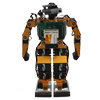
RoadNarrows introduces SkewlZone™, a suite of products designed to augment legged robots. Essentially, SkewlZone is an electronic brain and sensor pack. By design, SkewlZone products are a generalized system that can be used on many legged robots, providing these robots with sensors and computing power that walking robots on the market currently do not have.
Many of the popular legged robots operate almost entirely in open-loop. That is, the robots have no or limited sensory input from the environment outside of servo position and speed data. Manufacturer-supplied robot controllers are usually dedicated for the real-time control of 17 or more servos. They have little access capacity to process more complex sensory input from the environment and integrate these input streams with the current set of desired robot behaviors and high-level goals. Augmenting a legged robot with the SkewlZone endows it with far greater potential. An easy-to-program single board Linux computer (SBC) connects to SkewlZone add-on sensors, such as hand and foot tactile sensors, an inertial measurement unit, and a USB color camera. The Linux SBC is also connected to the the manufacturer’s servo controller to issue commands and receive timely servo state updates. Taken altogether, a robot with SkewlZone provides a platform with capabilites of motion, touch, balance, eyesight. Finally, a Wi-Fi conection is included for monitoring and for even more intense off-target AI applications.
Highlighted in the product suite is the SkewlZone™ Humanoid Foot. It gives the roboticist the ability to continuously measure the location of the center of gravity of the robot, the center of pressure on each foot, and the magnitude of force on the bottom of the foot. The toe also gives force feedback making it ideal for soccer competitions. Its on board LEDs give the user instant feedback on the foot’s current status and high visual appeal. An onboard Atmel® microcontroller comes preprogrammed with sensor calibration and operation controls, however, an I2C interface offers programmable control over all of the foot’s functions for advanced users. The feet can be used as stand-alone components, but their true value really stands out when integrated with RoadNarrows’ Linux SBC brain pack. Currently compatible with Kondo and Manoi Robots.
Links
Principal Investigator for National Science Foundation Phase 1 grant: NSF IIP-1113964 SBIR Phase I: Scalable Computer Clusters Applied to Sensing and Control of Intelligent Manipulators for Agile Manufacturing (2011). NSF grant
Principal Investigator for National Science Foundation Phase 1 and 2 grants: NSF IIP-0848762, STTR Phase I/II: General Robot Controller for Legged Mobile Robots with Integrated Open Source Software (2009). NSF grant
Weinberg, J.B., W. Yu, K. Wheeler-Smith, R. Knight, R. Mead, I. Bernstein, J. Croxell, & D. Webster (2008). Making Intelligent Walking Robots Accessible to Educators: A Brain and Sensor Pack for Legged Mobile Robots. Technical Report of The 2008 Association for the Advancement of Artificial Intelligence (AAAI-08) Workshop on AI Education, Chicago, IL, paper
Wheeler, K.M. (2007). RoadNarrows Presents General Purpose Brain-Packs, Controller Boards, and Robots for Education and Research, AAAI Spring Symposium 07, Stanford, CA. paper
tags: STEM - robotics - humanoid - robots